“Those cruelties we may say are well
employed, if it be permitted to speak well of things evil, which are done once
for all under the necessity of self-preservation, and are not afterwards
persisted in, but so far as possible modified to the advantage of the governed.
Ill-employed cruelties, on the other hand, are those which from small
beginnings increase rather than diminish with time. (…) Hence we may learn the
lesson that on seizing a state, the usurper should make haste to inflict what
injuries he must, at a stroke, that he may not have to renew them daily, but be
enabled by their discontinuance to reassure men’s minds, and afterwards win
them over by benefits.” (Chapter 8, Paragraph 9)
Reference: Nicolo Machiavelli. The Prince, trans. N.H. Thomson. Vol. XXXVI, Part 1. The Harvard
Classics. New York: P.F. Collier & Son,1909–14; Bartleby.com, 2001.
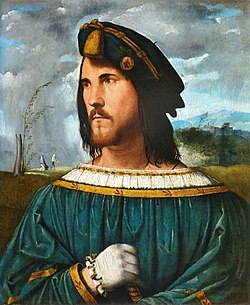
www.bartleby.com/36/1/. [09-03-2013]. Image: A. Melone. Portrait of a gentleman aka Cesare Borgia. 1500-1525.
Modern
political philosophy was born with the completion of Machiavelli’s Il
Principe or the Prince, in 1515, the same year More
started work on his Utopia. The two works could not be more
different: whereas More was trying to flee 16th century England
on the wings of his imagination, Machiavelli remained firmly rooted in the
rich, blood-stained earth of fractured Italy, which was made up of several
extremely wealthy city states that waged constant war on each other.
More’s Utopia describes a city that caters to the needs of
very good, morally upright people, people that celebrate democracy, diligence
and learning. Machiavelli had rather a different audience in mind.
According
to him, people long for power above all things. The Prince offers
practical advise on how to gain power and how to keep it. Machiavelli adds the
necessary colour to his prose by frequently referencing the deeds of past kings
and emperors. In his anecdotes Machiavelli does not distinguish between tyrants
and saints. He measures the greatness of an empire by its glory and wealth, not
by the happiness of its citizens or the ethics of its ruler. This is, perhaps,
the greatest schism between Machiavelli and his predecessors: the divorce of
ethics from politics.
Machiavelli
explains how the cruelty of a ruler is fair, and necessary, if applied
correctly, that is, rationally. The master of well-employed cruelties was
surely Cesare Borgia, a Duke, Cardinal and Politician at whose court
Machiavelli served in the winter of 1502 AD. The history of how Borgia quelled
the rebellion in Romagna is one of the most infamous anecdotes of the book;
Borgia ordered his friend Ramiro d'Orco to crush the rebellion using any force
he deigned necessary. The mission was a great success, but the authority that
d’Ocro gained as a result made Borgia nervous. So, he had the man publicly
executed in the piazza of Cesena, confident that by the elimination of this potential
enemy, he would also conveniently clear his reputation with the citizens of the
town. According to Machiavelli, in order to be
a successful ruler immorality is a prerequisite. Morality has use only in
subjecting the people and glorifying the prince, and is not, in and
of itself, something valuable or commendable.

No comments:
Post a Comment
Note: only a member of this blog may post a comment.