This blog was initiated as an examination for a course at the University of Leiden. The course is called History of Modern Political Philosophy. It is taught by Antwerp-bound scholar Herbert de Vriese. This blog serves to give a short introduction to the subject, exploring some of the major themes of political philosophy: authority, legitimacy , obedience and societal values. The works that will be used to expound on these subjects are: Utopia by Thomas More, the Prince by Nicolo Machiavelli, Leviathan by Thomas Hobbes, the Second Treatise of Government by John Locke, and the Social Contract by Jean-Jacques Rousseau.

Wednesday, 27 February 2013

Thomas More: on the Brink of Modernity

“When Raphael had finished his story, I was left thinking that not a few of the custom and laws he had described as existing among the Utopians were quite absurd (...) my chief objection was to the basis of their whole system, that is, their communial living and their moneyless economy. This one thing alone takes away all the nobility, magnificence, splendor, and majesty which (in the popular view) are the true ornaments of any commonwealth.” (p 588)

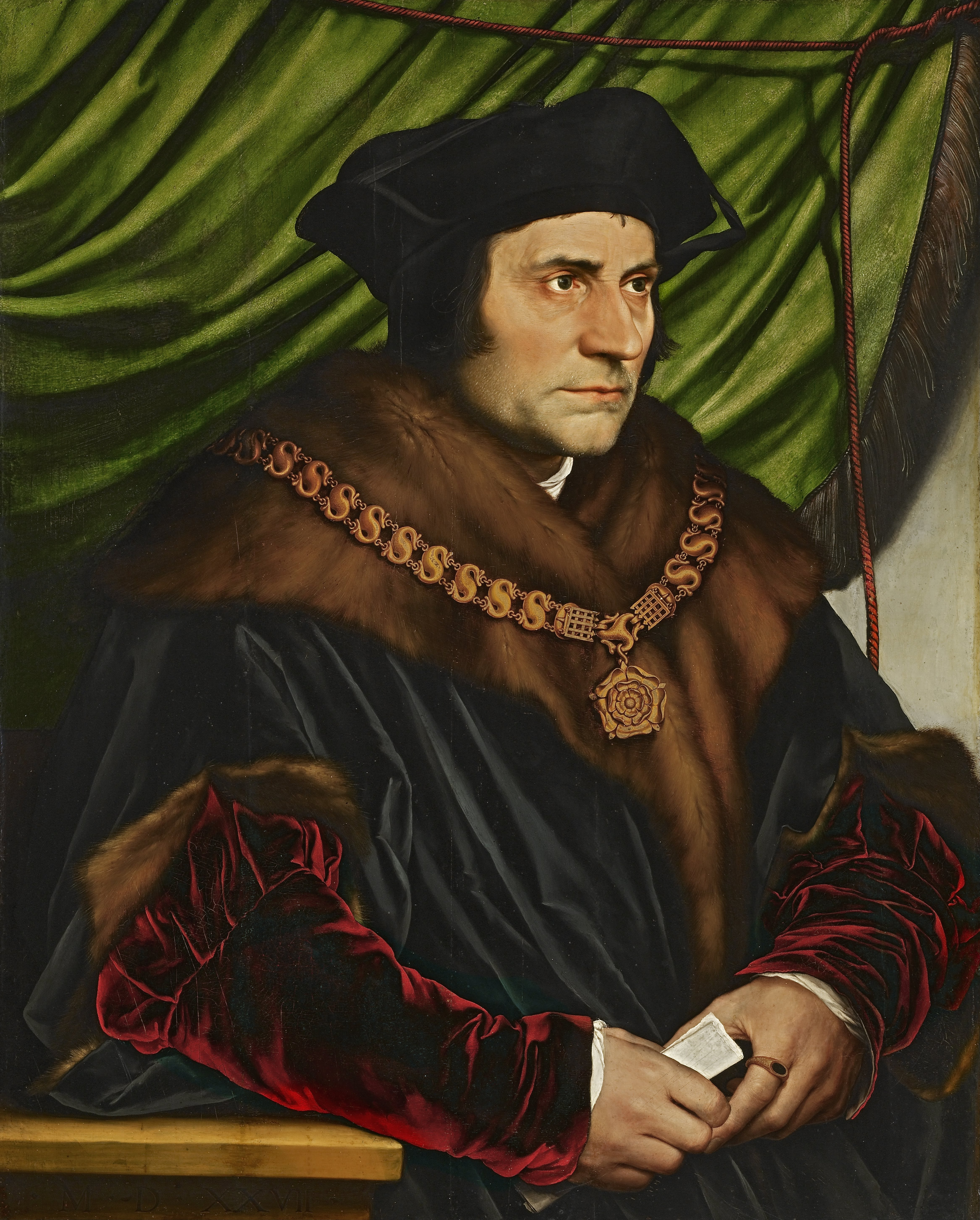
File:Hans Holbein, the Younger - Sir Thomas More - Google Art Project.jpg
Reference: Thomas More, Utopia, S. Greenblatt (ed) M.H. Abrams (ed) The Norton Anthology of English Literature, eighth edition, Volume 1. Norton & Company, Inc., 2006. p 553 Image: H. Holbein, the younger. Portrait of Thomas More 1527. 

Thomas More was a political thinker on the brink of modernity. His most famous work, Utopia, is the product of a fierce sense of religious and political disillusion. More vents his objections in a manner that anticipates the characteristic method of modern political philosophers: the thought experiment.

Although it masquerades as literary fiction, Utopia is certainly a thought experiment. It gives an image of a society that has developed untouched by Christianity or by any other political conventions that reigned in 16th century Europe. It is a society devised purely according to reason. The island is ruled democratically, private property does not exist and everybody is included in the division of labour, even women. As a result people only work six hours a day, and are free to pursue any kind of recreation they want, granted of course that they do so conscientiously and without disturbing the peace.


Despite the radicalism of his ideas More is not the first modern political philosopher. Crucially, though Utopia is a construct of reason, and completely unprecedented in many aspects, it is not truly offered as an alternative alongside, say, More’s own England. On the contrary, More needs Utopia to be as far away from the known world as possible. Equally, he needs it to be described by the dubious figure of Raphael Hythloday, whose name roughly translates to ‘Speaker of nonsense’ all in order to discredit a society that has flourished without God. Since More was fiercely Catholic (a quality which cost him his life when Henry IIX declared himself head of the Anglican church) he found it impossible to fully commit to Hythloday’s heretical vision. The objections made by the fictional More of the story, would have mirrored the historical More's own qualms with Utopia.

 In this respect More differs from another political thinker, the first one accurately called ‘modern’, a contemporary from wealthy, decadent, and war-torn Italy: Nicolo Machiavelli. 

Thursday, 21 February 2013

Introduction to Modern Political Philosophy

What is it that makes modern political philosophy modern? Equally important: how and when did this shift occur? Did it happen gradually, or was it sudden and poignant, like the flash of light that takes the hiker by surprise as he stumbles out of the undergrowth and into the open field.

In order to explain what is ‘modern’ about the modern political philosopher it is wise to start by looking at where he came from. We have to delve into the metaphorical undergrowth and explore the tracks. We need not go far. In 1517 Martin Luther unleashed the Reformation by pinning his 95 theses onto the door of the All Saints’ Church at Wittenberg. The following age was principally concerned with the awesome resonation of that act. Through study and prayer both Catholics and Protestants sought to corroborate their faith. Although initially their endeavours to educate themselves were meant as a means to arm themselves against each other, the 17th century saw the rise of a much bigger foe: science.

The religious certainties that both Protestantism and Catholicism offered were wildly incompatible with those posited by science. The Enlightenment (1697-1789) formed the answer to this crisis. It had radical consequences for the modern political philosopher. It freed thought from its prison of tradition and ethics. The modern political philosopher does not take any authority or customs for granted. He liberates his imagination and draws insight from eclectic disciplines as science, literature and religion. All the while he is constantly starting from scratch, using as a guide only what he finds within himself: his reason and his own moral code.