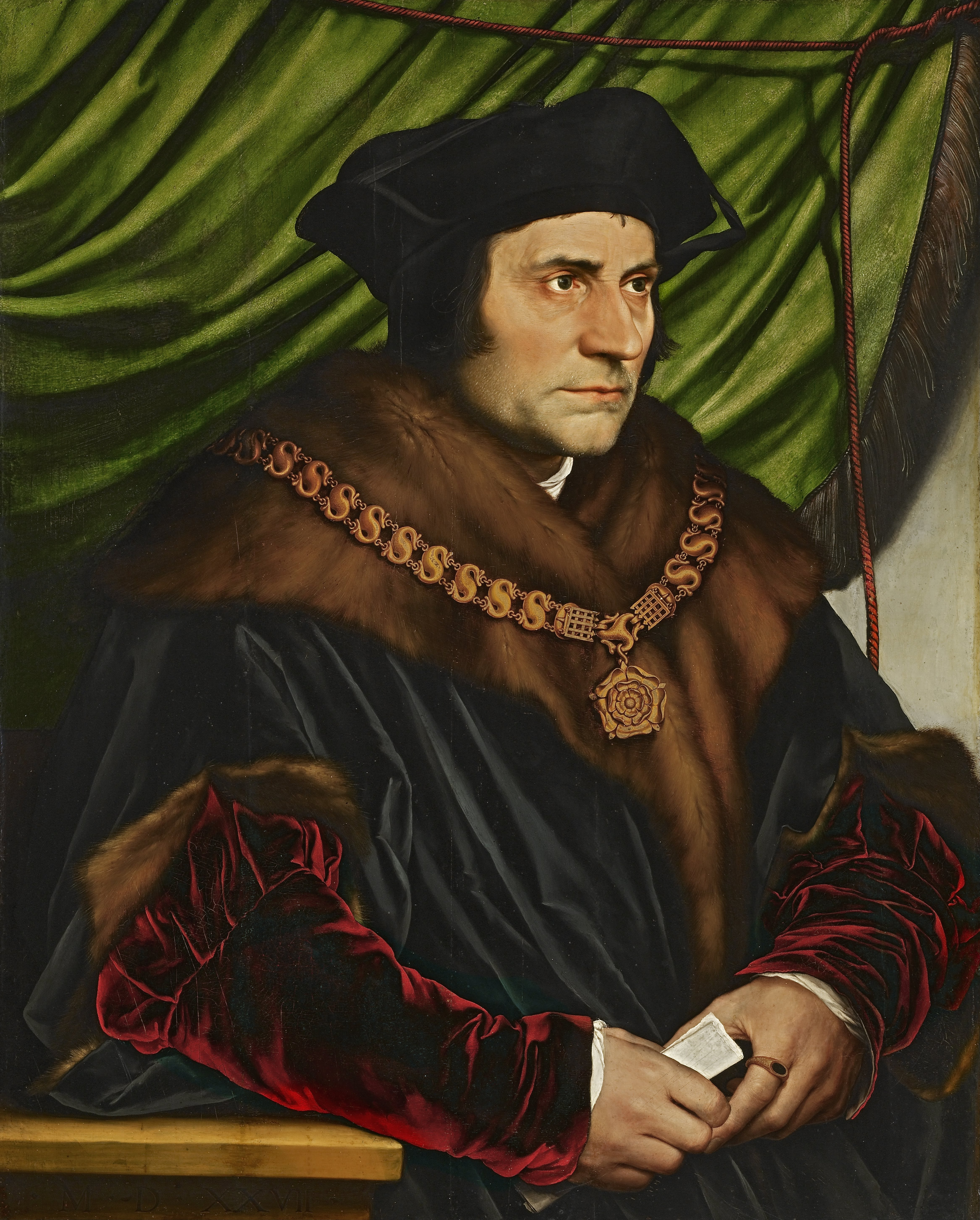
Thomas
More was a political thinker on the brink of modernity. His most famous work,
Utopia, is the product of a fierce sense of religious and political disillusion.
More vents his objections in a manner that anticipates the characteristic
method of modern political philosophers: the thought experiment.
Although
it masquerades as literary fiction, Utopia is certainly a thought experiment.
It gives an image of a society that has developed untouched by Christianity or
by any other political conventions that reigned in 16th century Europe. It is a society
devised purely according to reason. The island is ruled democratically, private
property does not exist and everybody is included in the division of labour,
even women. As a result people only work six hours a day, and are free to
pursue any kind of recreation they want, granted of course that they do so
conscientiously and without disturbing the peace.
Despite
the radicalism of his ideas More is not the first modern political philosopher.
Crucially, though Utopia is a construct of reason, and completely unprecedented
in many aspects, it is not truly offered as an alternative alongside, say,
More’s own England. On the contrary, More needs Utopia to be as far away from
the known world as possible. Equally, he needs it to be described by the
dubious figure of Raphael Hythloday, whose name roughly translates to ‘Speaker
of nonsense’ all in order to discredit a society that has flourished without
God. Since More was fiercely Catholic (a quality which cost him his life
when Henry IIX declared himself head of the Anglican church) he found
it impossible to fully commit to Hythloday’s heretical vision. The objections made
by the fictional More of the story, would have mirrored the historical More's own
qualms with Utopia.
In
this respect More differs from another political thinker, the first one
accurately called ‘modern’, a contemporary from wealthy, decadent, and war-torn
Italy: Nicolo Machiavelli.

No comments:
Post a Comment
Note: only a member of this blog may post a comment.