Thomas Hobbes. Leviathan. J.C.A. Gaskin
(ed. & introduction). Oxford World's Classics. Oxford University Press.
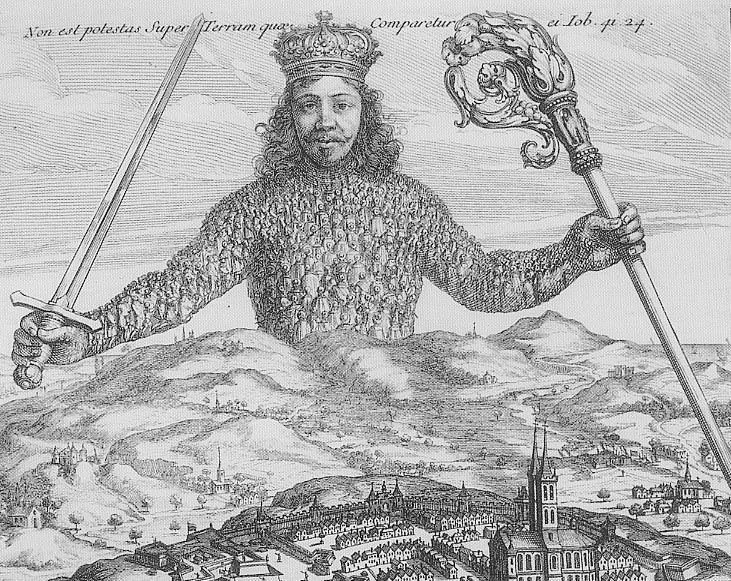
2008. Image: Leviathan, detail of titlepage. 1750. Mansell Collection.
 Hobbes' interpretation of the nature of mankind lies at the heart of his theory of politics.
His misanthropic view of mankind clashes with the ancient Greek observation
of man as a sociable animal. For a more visual image of Hobbes' pessimism it
may be insightful to turn to Hobbes' description of the state of nature, which
is not, as many people falsely interpret, a historical reality, but merely a
construct of reason. Hobbes devised it to explain and legitimize his
proposed political order: absolute monarchy.
The state of nature is a thought experiment in which a world is conceived where there is no law, no authority and, consequently, no morality. It is peopled by anti-social individuals possessed with an instrumental rationality which enables them to get what they desire. They have what Hobbes called a Natural Right over everything, because they are free, by reason, to obtain and abuse everything in order to advance their own lot. Because physical strength can be outmatched with cunning, no man can elevate himself above others. From this situation of equality is bred a war of all against all. The competition is not solely because of the scarcity of goods, and therefore should not be imagined as Darwinian, or likened to the natural competition between animals. There is a crucial difference. If a lion and a gazelle gather around a watering hole, both fed and content, there is no strife. Not so with man. Pride and ambition as well as the recognition of these vices in the other, will lead men to wage a perpetual war. Moreover, the process is viciously circular: the anticipation of violence will lead only to more violence.
Interestingly, in the natural condition man’s rationality is perhaps both his doom and his salvation, for man is both able to anticipate the worst and conceive of the best possible solution. If the worst fate is death, the best possible outcome therefore, must at least offer security of life and possibly some extra comforts. It is irrational to accept anything less than this. Hobbes' reliance on the mandates of rationality is his pivotal argument. According to Hobbes, people do not act contrary to their reason, and so, if a reasonable solution to the war of all against all were to announce itself, people would be obliged, by Natural Law, that is by the workings of their own mind, to accept.
 Hobbes' interpretation of the nature of mankind lies at the heart of his theory of politics.
His misanthropic view of mankind clashes with the ancient Greek observation
of man as a sociable animal. For a more visual image of Hobbes' pessimism it
may be insightful to turn to Hobbes' description of the state of nature, which
is not, as many people falsely interpret, a historical reality, but merely a
construct of reason. Hobbes devised it to explain and legitimize his
proposed political order: absolute monarchy.
The state of nature is a thought experiment in which a world is conceived where there is no law, no authority and, consequently, no morality. It is peopled by anti-social individuals possessed with an instrumental rationality which enables them to get what they desire. They have what Hobbes called a Natural Right over everything, because they are free, by reason, to obtain and abuse everything in order to advance their own lot. Because physical strength can be outmatched with cunning, no man can elevate himself above others. From this situation of equality is bred a war of all against all. The competition is not solely because of the scarcity of goods, and therefore should not be imagined as Darwinian, or likened to the natural competition between animals. There is a crucial difference. If a lion and a gazelle gather around a watering hole, both fed and content, there is no strife. Not so with man. Pride and ambition as well as the recognition of these vices in the other, will lead men to wage a perpetual war. Moreover, the process is viciously circular: the anticipation of violence will lead only to more violence.
Interestingly, in the natural condition man’s rationality is perhaps both his doom and his salvation, for man is both able to anticipate the worst and conceive of the best possible solution. If the worst fate is death, the best possible outcome therefore, must at least offer security of life and possibly some extra comforts. It is irrational to accept anything less than this. Hobbes' reliance on the mandates of rationality is his pivotal argument. According to Hobbes, people do not act contrary to their reason, and so, if a reasonable solution to the war of all against all were to announce itself, people would be obliged, by Natural Law, that is by the workings of their own mind, to accept.

No comments:
Post a Comment
Note: only a member of this blog may post a comment.